SAFEX International: Overview and Legal Disclaimers

SAFEX International operates independently and is not classified as a Trade Association. The organization primarily focuses on critical issues pertaining to safety, health, environmental protection, and security in relation to explosives and their precursor chemicals throughout the entire product life cycle.

To support these objectives, SAFEX International has developed a series of documents and guidelines known as the Basis of Safety (BoS). These materials have been collaboratively created by various member companies on an international scale, with the aim of enhancing safety standards in the operations, transportation, storage, and disposal of explosive products and hazardous chemicals.

It is important to note that the BoS documents are intended solely as training materials and guidelines for users. While SAFEX International strives to provide comprehensive and accurate resources, the organization expressly disclaims any legal liability arising from the application or execution of actions undertaken by individual users based on the content provided. Users are encouraged to exercise their own judgment and seek professional advice as necessary when implementing safety practices and protocols related to explosives and hazardous materials.

By utilizing the BoS documents and guidelines, users acknowledge and accept that SAFEX International cannot be held responsible for any consequences resulting from their actions or decisions.

SAFEX Newsletter

The SAFEX Newsletter was initiated for all members and other interested parties:

  • To inform the SAFEX Community of what is happening in SAFEX.
  • To provide a forum for readers to learn from the published articles and opinions expressed.
  • To encourage networking among members of the SAFEX Community.
  • To ensure SHE practices stay current and is shared.

Read the latest...

Incident Notification

Members can now notify SAFEX of incidents online by completing the Notification of Incident form after accessing the restricted pages (Intranet) with their access codes.

If your Company is a SAFEX Member and you don't have your individual access codes, please request them using the Member Nomination Form. Please do NOT use anyone else's access codes

Burning ground incidents – safe disposal of explosives

By Dr Martin Held

The recently reported burning ground incident that also caused fatalities is a stark reminder that the explosive industry continues to repeat those incidents.

Looking at the SAFEX incident database, we observe an average of one burning ground incident per annum for the past decade. Looking at categories, burning ground incidents are one if not the major contributor to incident statistics.

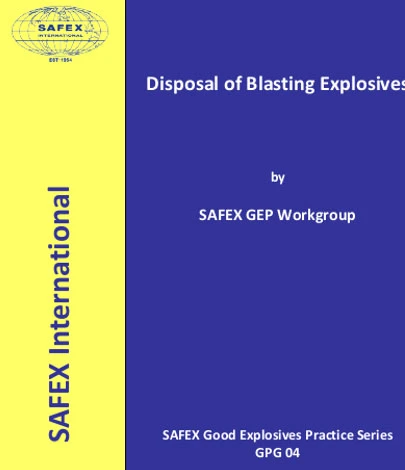
Almost a decade ago, SAFEX issued a Good Practice Guide on the Disposal of Blasting Explosives after a series of burning ground explosions that had occurred within our industry.

The GPG is looking in detail into burning ground operations, its hazards, controls, and design with a lot of visual examples of good and poor practices.

Even though when an explosion during a burning cycle is not expected, ‘it should always be assumed that explosion of the entire inventory could occur and, therefore, appropriate safety distances and good practices must always be implemented’.

This means that the layout of the burning ground and the setup of the burning operation depending on type and amount to be burnt may differ, but never the precautions to prevent injury and death.

Incident history shows that mixed waste, confinement, lack of training, and lack of change management (e.g. change of type of explosive to be burnt with the same setup, amount to be burnt, more energetic composition) are the most common causes for burning ground explosions. We must apply the same standards for waste disposal and burning as for any other step when handling explosive material. Burning ground operations should be inspected and audited in the same way as any normal explosives’ operation. When was your burning ground last audited ?

And keep in mind: Waste prevention comes first with the target to minimize the amount of explosives to be burnt !
RAM USED = 10.8 MO
TIME USED = 0.268 sec
PEAK RAM USED = 12.53 MO / 128 MO